Ratio Utility Billing System California: All You Need to Know
Utility costs in California keep climbing, yet many multifamily properties still rely on ratio utility billing systems (RUBS) to divide shared expenses. This method splits a master utility bill based on factors like unit size or occupancy instead of actual usage.
As a result, tenants often question their charges, and owners struggle to explain sudden increases or justify rising utility costs.
In this article, you’ll learn how a ratio utility billing system in California works, where it falls short, and why many property owners are rethinking this billing method.
TL;DR
A ratio utility billing system in California divides a master utility bill among tenants using allocation factors rather than actual usage.
Tenants pay a share of the building's total utility costs, which can raise fairness and transparency concerns.
Third-party billing fees and rate adjustments can increase monthly utility charges.
Submetering bills each unit for actual consumption helps detect leaks earlier.
DrizzleX provides fixture-level data and real-time alerts to reduce water waste and lower bills.
Understanding the Ratio Utility Billing System in California
A ratio utility billing system in California begins with one master bill for the entire property. The landlord or property management company receives that bill and divides the total among residents using a set calculation.
Each tenant pays a portion of the building’s utility expenses rather than paying for their exact utility consumption. Charges may include water and sewer costs, gas, and electricity used in common areas.
The total bill doesn't change, but the method used to divide it determines each resident’s monthly utility bill.
Under the RUBS method, charges are typically based on factors such as:
Number of units in the building
Unit square footage
Number of bedrooms or bathrooms
Number of occupants in each unit
These inputs estimate what each household should contribute.
Simple Example of a RUBS Water Bill
Imagine a ten-unit building receives a $1,000 water bill. If the landlord divides the bill evenly by the number of units, each tenant pays $100.
However, costs can increase. If the owner recalculates the bill using a higher residential rate instead of the commercial rate, the total may rise to $1,200.
Divided by ten units, each tenant now pays $120.
How Third-Party Billing Companies Affect RUBS Bills
Many landlords hire a third-party utility billing company to manage RUBS payments. These companies often add service fees.
Using the same example, if a $5 processing fee is added per unit, the monthly charge increases from $120 to $125. Over time, these added fees can significantly raise utility charges for residents.
Can Landlords Use RUBS in California?
Yes, landlords can generally use RUBS in California. Many multifamily property owners use a RUBS program in buildings with multiple units that don’t have individual meters.
Before implementing RUBS utilities, landlords and property managers need to clearly disclose any new utility charges.
Residents should understand how their portion of the property’s utilities is calculated and what services are included. Transparency helps reduce landlord-tenant disputes and repeated phone calls about billing.
Cities may have additional rules, so property managers must review local requirements before adopting a new policy.
When tenants understand how their fair share is determined, there’s less confusion and fewer complaints about unexpected utility charges.
The Downsides of Ratio Utility Billing Systems
RUBS often creates tension when residents don’t see a clear link between their utility usage and their monthly charges.
In a master-metered building, individual units aren’t measured separately. Tenants pay based on a predetermined formula, not on how much water, gas, or electricity they personally use.
A single person in a single-unit residence may pay nearly as much as a household that runs more appliances or uses more water fixtures. When bills increase, residents may assume the RUBS formula benefits the property more than the tenant.
Access to details is another concern. Many tenants can’t review the full master bill or understand exactly how RUBS calculated their share.
According to Shelterforce, Los Angeles tenant Joe Porter saw his bundled charges for water, trash removal, and pest control rise from about $60 to nearly $200. When he asked for clarification, he was told a third party handled the billing, and no detailed breakdown was available.
When residents can’t verify charges, complaints increase, and trust declines.
Why Submetering Is a Better Alternative to RUBS
A ratio utility billing system distributes costs based on an estimate. Submetering bills each unit for its actual water or energy consumption. That difference affects both fairness and financial performance.
When residents pay for what they use, billing becomes easier to justify. Tenants can clearly see the connection between their habits and their monthly charges, which reduces pressure to offset rising utility expenses through rent increases.
Submetering also eliminates operational blind spots. In a master-metered property, a usage spike appears only as a higher total bill, with no indication of which unit caused it.
According to the U.S. Environmental Protection Agency, a dripping faucet can waste more than 3,000 gallons per year. In a multifamily building, a few unnoticed leaks can quickly inflate costs.
With multi-tenant submetering, property managers can detect excessive use earlier, respond faster, and recoup costs with greater precision.
How DrizzleX Gives Property Owners Clear Water Usage Data
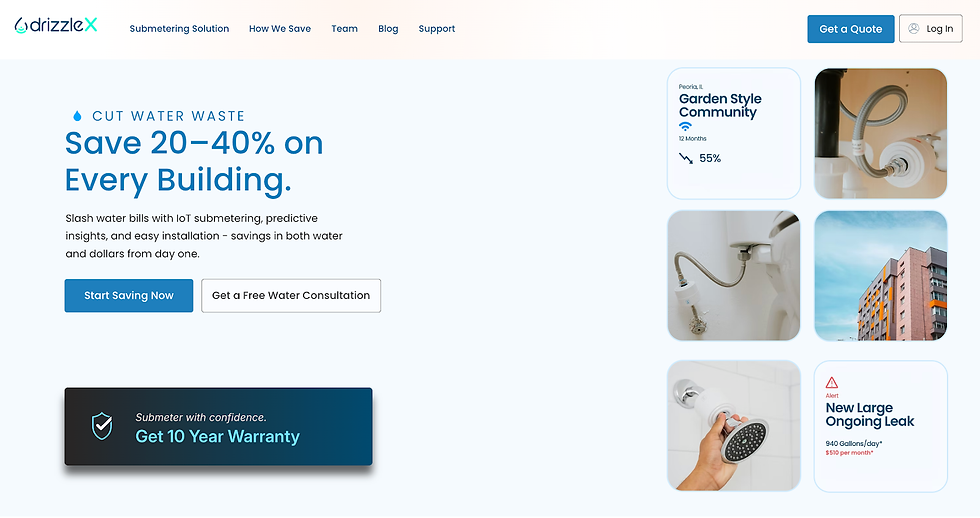
A ratio utility billing system in California allocates costs. DrizzleX measures actual water usage at the source.
That distinction changes how property owners manage expenses, respond to leaks, and improve transparency with residents.
Fixture-Level Micrometers With No Pipe Cutting
DrizzleX installs smart water meters on sinks, toilets, showers, and bathtubs inside each unit. Installation takes about 15 minutes per apartment.
There’s no pipe cutting or wall openings, which avoids disruption to residents and building materials.
A typical apartment includes seven micrometers that monitor kitchen and bathroom fixtures. Batteries last up to ten years. Most properties operate with one cloud gateway that collects data from the entire building.
Real-Time Leak Detection and Alerts
Each micrometer records water flow and transmits data continuously. When unusual activity appears, the system flags the issue.
Property managers can see the exact unit and fixture responsible. AI compares usage patterns to occupancy estimates and historical trends to identify abnormal consumption early.
That insight helps address leaks before costs escalate.
38% Water Reduction in a 65-Unit Los Angeles Property

In Los Angeles, California, a 65-unit property with 144 tenants completed a full DrizzleX installation. Over an eight-month report period, average daily water use dropped from 21,393 gallons to 13,326 gallons.
The property achieved a 38% reduction in water consumption, saving $65,797. With a local water rate of $16.79 per HCF, the average monthly cost per unit decreased from $221 to $138.
Each unit saved approximately 5 HCF per month, showing how fixture-level monitoring can deliver substantial financial savings.
Influence Tenant Behavior With Usage Data
When residents see their own water usage, habits often change. DrizzleX allows property managers to share consumption insights and support usage-based tenant billing.
The dashboard shows portfolio-level data in one place. For owners who want to control utility expenses without raising rents, fixture-level submetering provides data that an RUBS can’t match.
FAQs About Ratio Utility Billing System in California
Is ratio utility billing legal in California?
In most cases, yes. California allows landlords to allocate shared utility costs in master-metered buildings, provided they follow state and local requirements.
Some cities impose additional conditions, so property owners should confirm local rules before applying a RUBS program.
How to calculate the ratio of utility billing?
RUBS divides a master utility bill among tenants using factors such as unit size, number of occupants, or bedrooms. The total building bill is multiplied by each unit’s assigned percentage. The result becomes the tenant’s monthly utility charge.
Does the 30% rent rule include utilities?
Yes, the 30% rule generally includes basic utilities such as electricity, water, and heating in addition to base rent.
It suggests that total monthly housing costs shouldn’t exceed 30% of a tenant’s gross income, which helps determine whether a rental is affordable.
Do tenants need to make 3x the rent?
No, tenants don’t need to make three times the rent in most areas. The 3x rent rule is a common screening guideline used by landlords.
It’s typically based on gross monthly income before taxes and helps show that tenants can afford rent and essential expenses, including utilities.


