Cut Water Costs With a Better Utility Billing Process
Utility bills rarely draw attention until something goes wrong. A sudden spike, a disputed charge from utility providers, or repeated late payments can quickly strain your budget.
In multifamily properties, utility costs don’t just affect operating expenses. They determine whether owners absorb tenant usage or recover it fairly.
An effective utility billing process protects revenue, flags leaks early, and prevents shared costs from draining property value.
This guide explains how property managers can tighten oversight and stop water losses before they escalate.
TL;DR
The utility billing process covers collecting usage data, verifying charges, allocating costs, and paying invoices accurately.
In multifamily properties, weak oversight leads to overcharges, delayed leak detection, and revenue loss.
Automation improves billing accuracy and identifies abnormal utility consumption earlier.
IoT submetering replaces shared water estimates with fixture-level usage data for fair tenant billing.
DrizzleX helps properties cut water costs by 20–40% and charge tenants based on actual consumption.
The Utility Billing Process Overview
The utility billing process manages how a household, business, or property receives, verifies, allocates, and pays invoices for electricity, water, gas, waste, and HVAC services.
For property managers and owners, this process directly affects operating budgets, resident billing, and net operating income. In multifamily housing, utility costs often rank among the largest controllable expenses.
Managing utility bills requires accurate billing, disciplined review of consumption details, and careful tracking of contract terms and due dates.
When oversight slips, manual data entry errors, duplicate charges, and missed discrepancies follow.
Faulty billing data increases utility spending and slows cost recovery.
The Risks of an Inefficient Utility Billing Process
Utility expense management now demands greater precision. Complex rate schedules, tiered pricing, and evolving utility billing regulations increase the risk of overpayment.
According to the National Association of Realtors, 32% of buyers consider utility and operations costs very important when evaluating properties. Investors and tenants now scrutinize energy usage and water consumption more closely.
Weak utility bill processing leads to:
Overcharges that remain undetected
Late fees from missed due dates
Service interruptions
Landlord-tenant disputes over cost allocation
Regulatory exposure
On the other hand, an efficient process leads to improved billing accuracy, stronger utility bill auditing, and makes it easier to spot anomalies in consumption patterns.
How the Utility Billing Process Works
An effective utility billing process follows a disciplined sequence. When one component breaks down, billing errors, overpayments, and disputes follow.
1. Utility Data Collection and Meter Readings
Everything starts with meter data. Electricity, gas, and water readings need to reflect actual usage, not estimates pulled from outdated records.
In master-metered buildings, inaccurate readings distort utility consumption totals and complicate resident allocations. A single inflated water reading can mislead budgeting decisions for an entire quarter.
Reliable data accuracy at this stage prevents inaccurate figures from flowing into the rest of the billing process.
2. Utility Invoice Processing and Data Entry
Utility invoice processing captures account numbers, billing amounts, usage totals, and due dates. Most properties still rely on manual data entry, which increases the risk of human errors and duplicate charges.
Utility bill management software imports billing data from online portals and supplier feeds. Specialized software solutions replace spreadsheets and speed up processing.
When systems capture data accurately, property managers focus on reviewing utility spending instead of fixing mistakes.
3. Invoice Verification and Audit
Verification compares invoice charges with meter readings and contract terms. This review helps identify billing errors, incorrect rates, and unexplained spikes in energy consumption or water usage.
Utility bill auditing also detects irregular water usage patterns. In multifamily housing, a steady rise in water consumption often signals a hidden leak or excessive usage from a specific unit.
Without verification, inflated final bills move into payment processing unchecked.
4. Approval and Cost Allocation
After verification, invoices move to approval before bill payment. Landlords confirm that charges reflect expected utility service levels and help control costs before payment is issued.
In multifamily properties, cost allocation determines how shared utilities are distributed among apartment units.
Accurate cost allocation protects cost recovery and minimizes arguments over shared utility expenses. Tenants expect billing based on actual usage, not estimates.
5. Payment Scheduling and Automation
Payment scheduling tracks due dates and prevents late fees. Missed deadlines damage relationships with utility providers and interrupt service.
Utility bill automation schedules digital bill payment and sends reminders before each due date. According to InvoiceCloud, 22% of consumers cite the absence of reminders as a barrier to digital payments.
Automated reminders improve timely payments and maintain financial stability.
6. Monitoring and Reporting
Monitoring continues after invoices receive payment. Reporting tools analyze historical data and track utility usage trends over time.
Property managers review energy consumption patterns, seasonal water usage changes, and abnormal spikes that may signal equipment failure or tenant overuse.
These insights highlight cost-saving opportunities and expose irregular utility spending before it escalates.
7. Ongoing Optimization and Conservation
Utility expense management extends beyond invoice approval. Property owners and managers evaluate energy consumption against sustainability goals and operational benchmarks.
Water leak detection devices identify continuous flow in toilets, sinks, or showers before the water leak detection cost escalates.
Ongoing anomaly monitoring protects properties from excessive utility consumption and unnecessary expense.
Common Challenges in the Utility Billing Process
Even well-run multifamily properties face recurring problems that weaken the entire billing process.
Estimated water usage in multifamily buildings: Properties with one master meter divide total water consumption evenly among tenants. This method ignores actual usage and hides high-consumption units. Without unit-level data, managers can’t identify discrepancies or justify charges.
Delayed leak detection: Most utilities send monthly statements. A running toilet can waste thousands of gallons before anyone reviews the invoice. Water leak detection cost inflates quickly when oversight depends on billing cycles instead of usage data.
Tenant overuse and billing disputes: Limited visibility into utility usage causes conflict. When tenants question charges, property managers lack the data needed to allocate costs fairly.
These obstacles prevent operators from identifying discrepancies and extracting valuable insights from billing data.
How Automation Improves the Utility Billing Process
Automated data collection pulls raw data from digital meters and online portals. Systems record billing data without manual entry, which improves accuracy.
Real-time monitoring tracks utility usage as it occurs. Dashboards present consumption trends for each property in one interface. You can identify discrepancies quickly and review historical data for actionable insights.
Utility bill automation schedules bill payment and enforces consistent deadlines. Faster processing shortens billing cycles and improves compliance with utility billing regulations.
Water management gains the most. Continuous monitoring detects leaks and abnormal usage long before monthly invoices arrive, preventing unnecessary expense and prolonged waste.
How IoT Submetering Can Improve the Water Utility Billing Process
Water billing presents a different challenge in multifamily properties. Electricity and gas usually track usage by unit, but water often doesn’t.
Owners receive one master bill, even though tenants drive individual consumption.
The Problem: Tenants Use Water, Landlords Pay the Bill
Most apartment buildings don’t have separate water mains for each unit. Riser plumbing connects apartments to shared vertical pipes, which prevents traditional submetering.
One master meter records total building consumption. Owners either divide the cost evenly or absorb the overuse themselves. That method ignores actual usage and makes fair cost allocation difficult.
When a spike appears on a monthly invoice, managers can’t see which unit caused it or whether a leak is involved.
Monthly billing cycles delay visibility. By the time high usage appears, thousands of gallons may already be wasted.
The Solution: Fixture-Level Smart Submetering
Fixture-level IoT submetering systems change how water data enters the utility billing process.
DrizzleX installs micrometers on sinks, showers, bathtubs, toilets, washing machines, hose bibs, and sprinkler systems.
A typical apartment includes seven micrometers. Installation takes about 15 minutes and requires no pipe cutting or wall openings. Batteries last up to ten years. One cloud gateway collects data from every micrometer on the property.
Instead of relying on building-wide totals, managers see water usage at each fixture. Billing reflects actual consumption, not averages.
Real-Time Leak Detection and Overuse Alerts
Each micrometer transmits water flow data continuously. The system monitors usage patterns and flags irregular behavior immediately.
Managers receive alerts when fixtures run longer than expected, when toilets leak continuously, or when usage spikes beyond normal trends. The dashboard identifies the exact apartment and fixture involved.
Property teams respond before waste escalates into inflated bills or property damage.
How Smart Water Monitoring Enhances Utility Bill Processing
Smart water monitoring systems improve utility invoice processing by replacing estimates with verified usage data.
When properties measure water at each fixture, invoices reflect actual consumption rather than shared averages.
Accounting teams pull that data into their billing systems, which lowers manual errors and removes time-consuming recalculations at month's end. The entire process becomes more precise, from usage recording to tenant charge.
Fixture-level visibility also helps managers identify areas of unusual consumption. Instead of reviewing one building-wide total, they examine specific units and fixtures.
That detail simplifies review and helps uncover several factors behind higher bills, such as leaks or extended run times.
Smart monitoring also replaces third-party billing services that rely on allocation formulas. Properties bill tenants using measured data from their own systems, which provides documented usage records for every unit.
When residents question a charge, managers reference documented usage history. Verified data speeds up resolution and supports cost reduction without relying on assumptions.
Simplify Water Billing Operations With DrizzleX
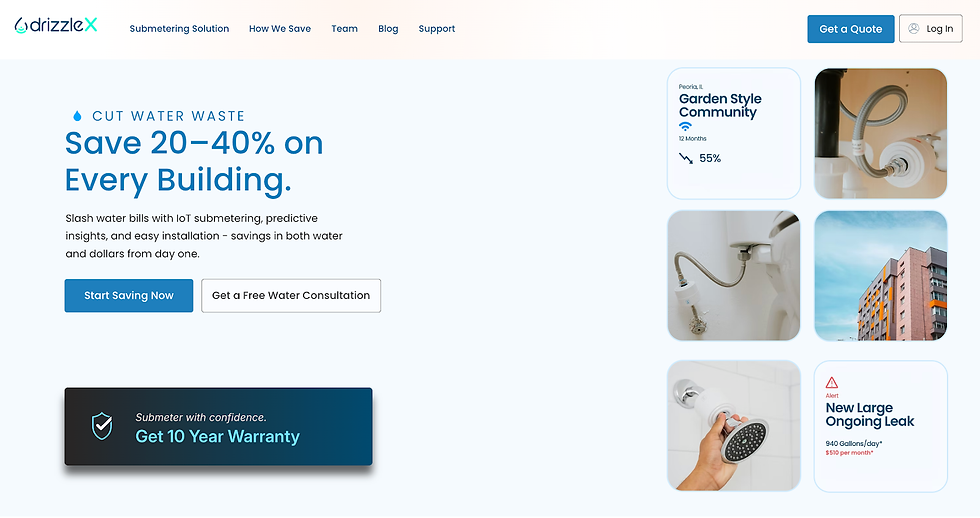
Traditional water billing depends on monthly statements and shared estimates. By the time those numbers reach your desk, excess usage has already driven up expenses.
Continuous water monitoring changes that pattern. Fixture-level data feeds into your billing system and records actual consumption for every unit.
Many DrizzleX customers report 20–40% lower water bills after moving away from shared allocations and billing based on measured use.
The return shows up quickly. Lower water expense improves net operating income (NOI) and increases property value without disruptive construction or lengthy installations.
DrizzleX detects waste early, documents usage by unit, and equips managers with data that holds up under review.
FAQs About the Utility Billing Process
What are the steps of the billing process?
The billing process includes collecting usage data, generating an invoice, reviewing charges for accuracy, approving the bill, and issuing payment. After payment, organizations reconcile records and monitor usage trends to spot irregularities.
How long until a utility bill goes to collections?
Most utility providers send accounts to collections after 30 to 90 days of nonpayment. Before that, they issue late notices and may warn of service interruption. Once in collections, additional fees and credit consequences can apply.
What is utility billing?
Utility billing is the process of charging for services such as electricity, water, gas, and waste. Charges are based on measured consumption, rates, and service fees. Property owners may also allocate these costs to tenants.
What is utility invoice processing?
Utility invoice processing refers to receiving, recording, verifying, approving, and paying utility bills. It confirms that charges match usage and contract terms before payment. Accurate processing prevents overcharges and accounting errors.


