
How Much Water Does the Average Shower Really Use?
RUBS vs. water submetering for multifamily owners: how they compare, when each makes sense, and what switching to actual-use billing involves.
How Much Water Does the Average Shower Really Use?
How much water does a shower take? The average American shower uses about 15.8 gallons: 7.8 minutes at 2.1 gallons per minute, according to the Water Research Foundation's 2016 Residential End Uses of Water study, as reported by the Alliance for Water Efficiency.
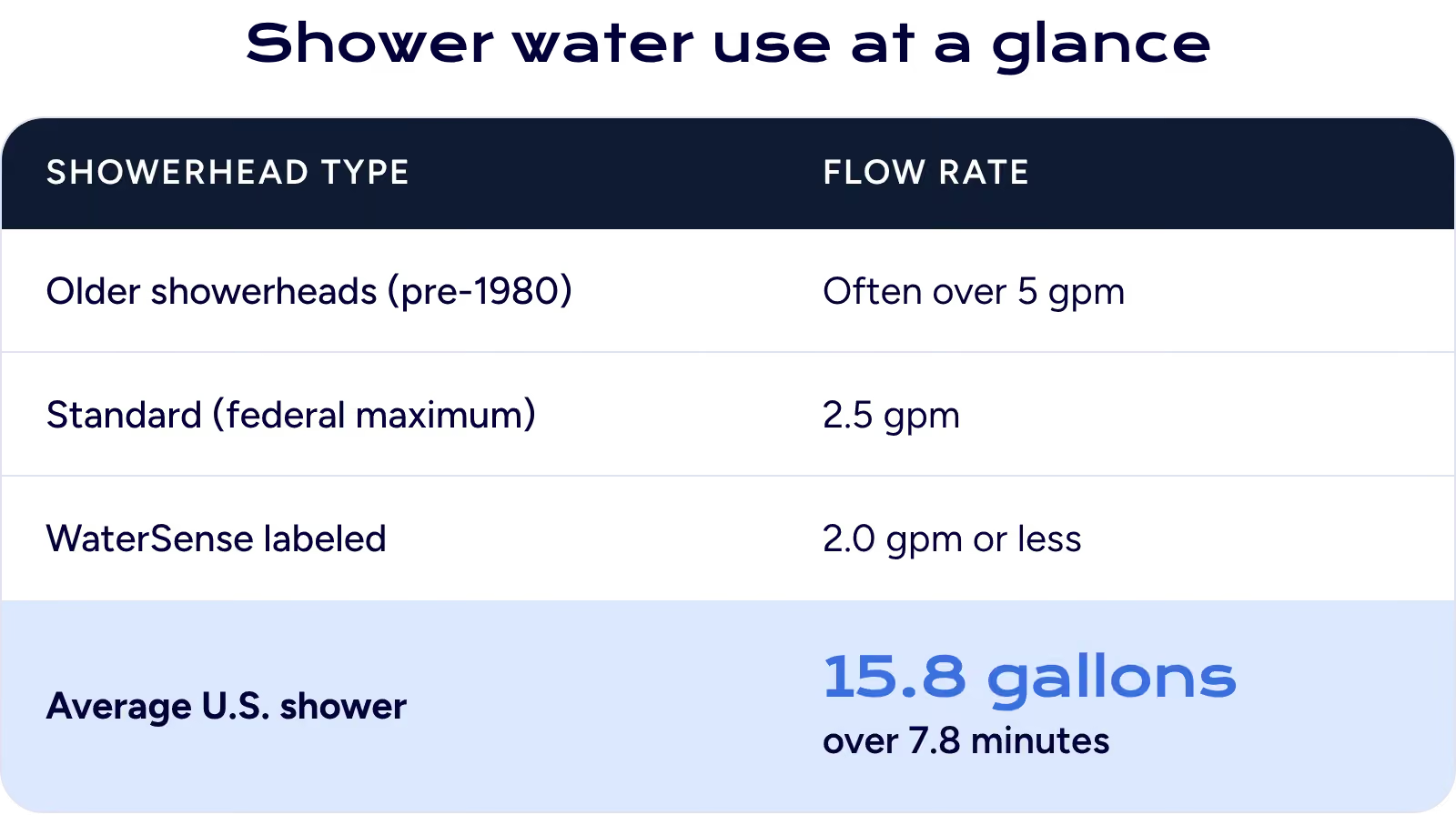
How many gallons does each type of showerhead use?
The showerhead sets the ceiling. A pre-1980 head can use more than twice the water of a modern one for the same shower.
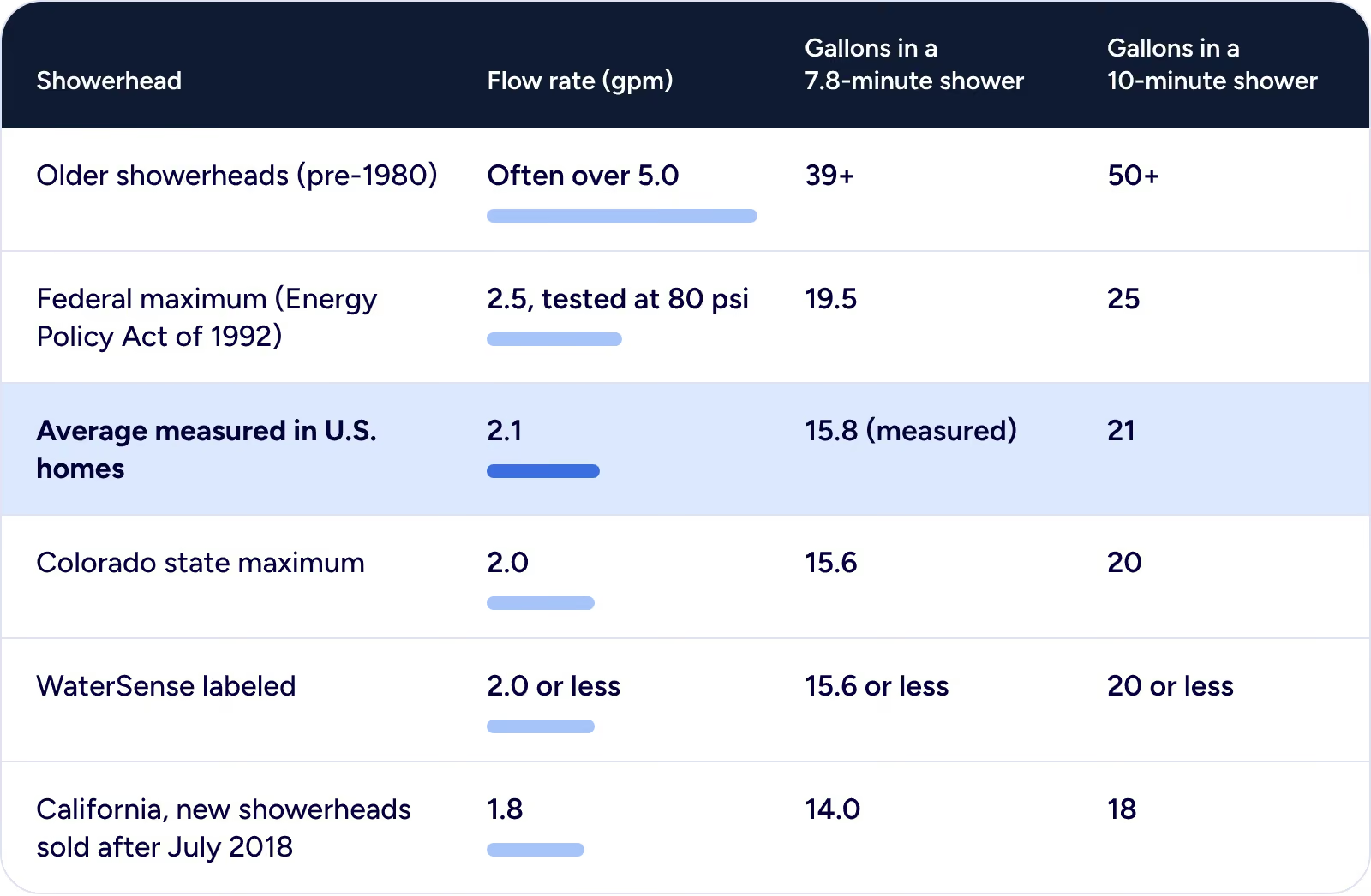
The gallon columns are flow rate × minutes at full flow. Real use depends on water pressure and how far the valve is open, which is why the measured average sits below the 2.5 gpm limit.
How do you work out your own shower's water use?
Multiply flow rate by minutes. That's the whole formula.
Gallons = flow rate (gpm) × minutes
To find your flow rate, time how long your shower takes to fill a one-gallon container. Divide 60 by the seconds. A bucket that fills in 24 seconds means 2.5 gpm.
Why is the average shower below 2.5 gpm?
Because 2.5 gpm is a maximum, not a typical reading. Federal rules cap standard showerheads at 2.5 gpm when tested at 80 psi, a limit set by the Energy Policy Act of 1992.
Showers in real homes run lower. The 2016 end-use study measured 2.1 gpm on average. An earlier EPA analysis put existing showerheads at 2.22 gpm.
One recent change cuts the other way. In April 2025, the Department of Energy withdrew a rule that had capped multi-nozzle shower systems at 2.5 gpm combined. The 2.5 gpm standard itself still stands.
How much of a home's water goes to the shower?
Showering accounts for nearly 17% of residential indoor water use, according to EPA WaterSense. For the average family, that adds up to nearly 40 gallons a day.
For scale, the U.S. Geological Survey estimates each person uses 80–100 gallons a day for indoor home uses. Only toilet flushing uses more than showers and baths.
How much does a shower cost?
A shower costs its gallons times your combined water and sewer rate. Most utilities bill per CCF (100 cubic feet), which is 748 gallons.
Cost = (gallons ÷ 748) × (water rate + sewer rate per CCF)
A 10-minute shower at the 2.1 gpm average uses 21 gallons, or about 0.028 CCF. Multiply that by the combined rate on your utility's rate schedule. The result leaves out the energy to heat the water.
How much hot water does a shower use?
About two-thirds of shower water is hot. A June 2020 Lawrence Berkeley National Laboratory study puts the hot-water share of shower use at 67.8%. For an average 15.8-gallon shower, that's about 10.7 gallons of heated water.
That's why a shorter shower or a lower-flow showerhead cuts energy bills as well as water bills.
Why showers matter in apartment buildings
In apartment buildings, showers make up roughly a third of normal water use. Toilets take about another third, and everything else the rest.
That split comes from DrizzleX, which measures water at the fixture level: a micrometer on individual showers, toilets and sinks. Because each fixture is read on its own, a shower left on too long stands out. At around 90 minutes, it triggers an alert.
Ninety minutes at the average 2.1 gpm is about 189 gallons — roughly a dozen average showers. Fixture-level leak and waste detection explains how those alerts reach a maintenance team.
FAQ
How many gallons does a 10-minute shower use?
A 10-minute shower uses about 21 gallons at the U.S. average flow of 2.1 gallons per minute, the rate measured in the 2016 Residential End Uses of Water study. With a showerhead at the 2.5 gpm federal maximum, it's 25 gallons. With California's 1.8 gpm limit, it's 18 gallons.
What is the average gallons per minute for a shower?
The average U.S. shower flows at 2.1 gallons per minute, according to the Alliance for Water Efficiency. Standard showerheads are capped at 2.5 gpm when tested at 80 psi. WaterSense-labeled models use 2.0 gpm or less, per EPA WaterSense.
How many gallons are in an average shower?
An average American shower uses about 15.8 gallons and lasts 7.8 minutes, according to the Water Research Foundation's 2016 end-use study. An older EPA analysis put it at 17.2 gallons over 8.2 minutes.
How many showers does the average person take a week?
The average person takes about 0.67 showers a day, or roughly four to five a week, according to an EPA WaterSense analysis. Habits vary widely by household.
Do low-flow showerheads actually save water?
Yes. EPA WaterSense estimates the average family can save 2,700 gallons a year by switching to one labeled showerhead. That's more than $75 a year in water and energy costs.
What share of household water use goes to showers?
Showering accounts for nearly 17% of residential indoor water use, according to EPA WaterSense. For the average family, that's nearly 40 gallons a day.
Fixture-level water intelligence
See every drop.
Keep every dollar.
Subscribe to newsletter
Solutions by building type
Solutions by use case
Resources
